
The Shore hoops roadmap
THE SHORE HOOPS ROADMAP • HOOP ATLAS NJ
The Shore Hoops Roadmap
A Parent’s Guide to the Youth Basketball Journey
About a 5–6 minute read
Youth basketball around the Shore can get complicated surprisingly fast.
At first, it’s simple: find a league, buy a basketball, and let your kid play. Then come travel teams, trainers, AAU, tryouts, camps, clinics, middle school basketball, bigger tournaments, and high school expectations.
Somewhere along the way, parents start wondering: Are we doing enough? Are we doing too much? Should my child be playing AAU? Do they need a trainer? Are we on the right team? What should we actually be focused on right now?
That’s why we created the Shore Hoops Roadmap. It isn’t a formula for producing college basketball players, and it isn’t a checklist every athlete has to complete. It’s a guide to understanding where your player is now—and what a useful next step might look like.
The ages are guideposts, not deadlines. You’ll notice some stages overlap. That’s intentional. Players develop at different speeds, and the right basketball environment should be based on where a kid is developmentally—not simply the age on their birth certificate.
So where is your player right now?
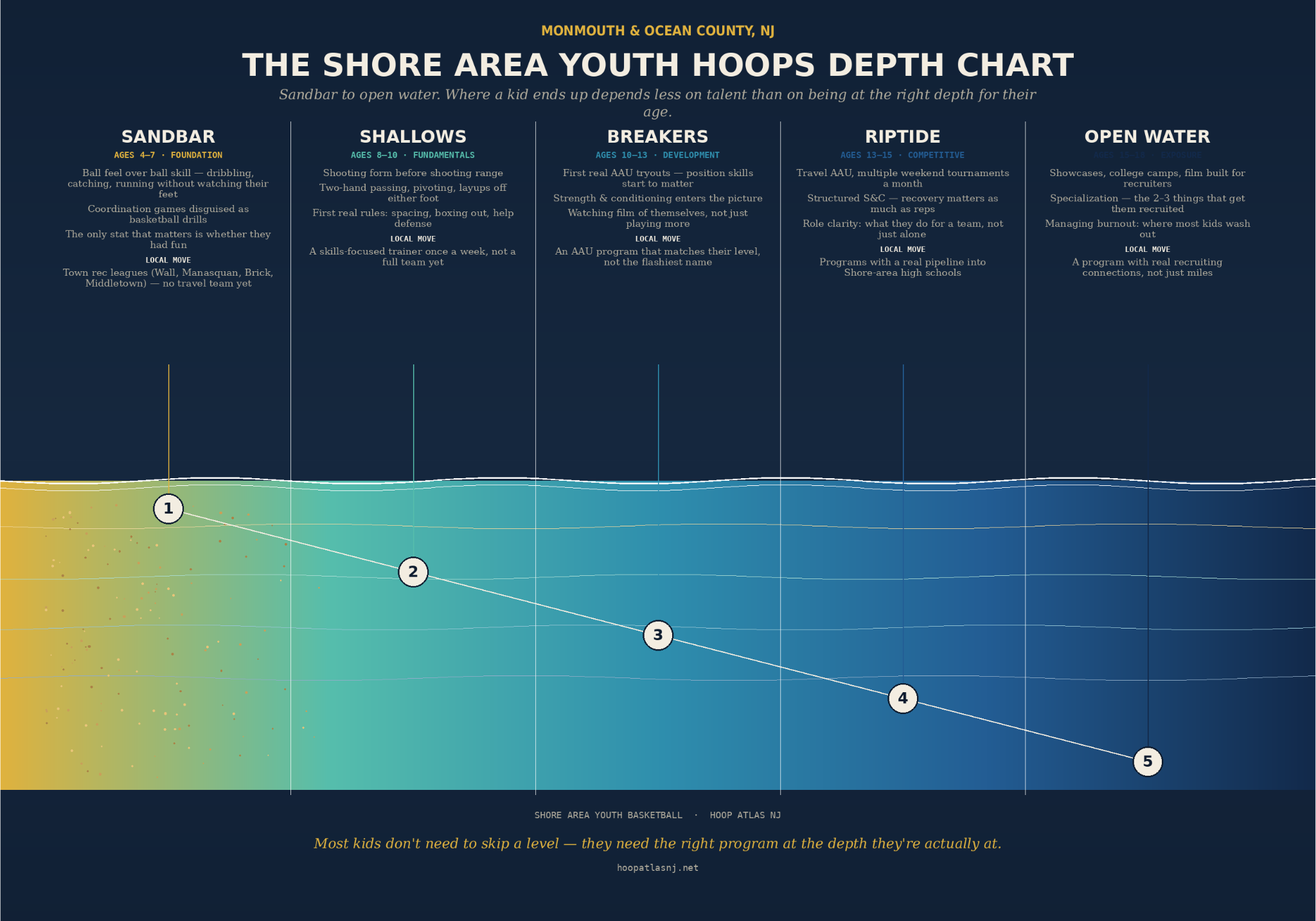
There isn’t one right path through Shore basketball. But there are recognizable stages, and what helps a player at one stage can be completely wrong for another. We think of the journey like heading out from the Shore: from the Sandbar to Open Water.
Hoop Atlas NJ
The Shore Area Youth Hoops Depth Chart
THE GOAL ISN’T TO GET TO DEEP WATER FASTER.
It’s to make sure your player is in the right environment for where they are today.
PHASE 1 — SANDBAR
AGES 4–7 • FOUNDATION
Fall in love with playing.
At this age, basketball should mostly feel like play. Kids are learning to dribble, catch, pass and shoot, but they’re also answering a more important question: Do I like basketball?
The best early experiences usually involve lots of movement, lots of touches and very little pressure. Recreation basketball, introductory clinics, driveway games and beginner camps can all be great options. A child doesn’t need a basketball résumé at seven. They need opportunities to play.
Don’t worry too much about whether your child is “ahead.” Kids develop at dramatically different rates at this age.
PARENT CHECKPOINT: Does my child want to come back and play again?
PHASE 2 — SHALLOWS
AGES 8–10 • FUNDAMENTALS
Build the skills that everything else depends on.
Basketball starts becoming more recognizable during these years. Kids can handle more instruction, games become more competitive, and some players begin separating themselves physically or technically.
This is also when parents start hearing more about travel basketball, private trainers and AAU. Those can all be valuable, but none of them are requirements. The priority is still development.
Players should build a foundation in ball handling, footwork, passing, shooting mechanics, finishing, defense, spacing and basic team concepts. It can also be a good time to experience different coaches through clinics, camps or small-group training. The objective isn’t to assemble the perfect basketball program. It’s to discover where your child learns best.
PARENT CHECKPOINT: Where will my child get good instruction and real opportunities to play?
PHASE 3 — BREAKERS
AGES 10–13 • DEVELOPMENT
Turn individual skills into basketball.
This can be one of the most confusing stages of youth basketball. Bodies begin changing. Competition increases. Travel and AAU become more prominent. Some kids grow quickly; others don’t. Players who dominated at 10 may struggle at 12, while others suddenly take off.
Basketball becomes less about simply having skills and more about using them in games. Can your player make decisions? Play without the ball? Defend? Handle pressure? Contribute when they aren’t scoring?
This is also where fit starts to matter. A player sitting on the bench for a prestigious team may develop less than a player getting meaningful minutes in a competitive environment that fits them.
Training can become more intentional, too. Instead of asking, “Do we need a trainer?” ask, “What does my child actually need help with?” The answer should help determine the trainer or program—not the other way around.
PARENT CHECKPOINT: Is my child becoming a better basketball player—or simply playing more basketball?
PHASE 4 — RIPTIDE
AGES 13–15 • COMPETITIVE
Prepare to contribute on increasingly competitive teams.
For many players, this is where basketball changes. There are fewer roster spots. Coaches have specific needs. Physical development, defense and decision-making matter more, and simply being able to score isn’t always enough.
The question starts changing from “How good is my child?” to “How can my child help a team win?”
Players should begin understanding what they reliably bring to a team. Maybe it’s ball security. Maybe it’s shooting, defense, rebounding, communication, energy or making the extra pass. Developing a basketball identity can be more valuable than trying to become great at everything at once.
The right competitive environment matters here, too. Look for coaching, meaningful reps and a level that challenges the player without burying them.
PARENT CHECKPOINT: If a high school coach watched my child tomorrow, what would that coach immediately know they can contribute?
PHASE 5 — OPEN WATER
AGES 15–18 • COMPETE & EXPOSURE
Maximize the high-school experience and determine what comes next.
By high school, the basketball world gets smaller. Some players are chasing varsity minutes. Some want to become starters. Some want to play college basketball. Others simply want to compete with their friends and make the most of their remaining years in the game. All of those are legitimate goals.
Development should become increasingly specific to the player’s role and goals. Film, honest feedback and conversations with coaches become especially useful: find the gaps, work on them, measure progress and adjust.
For players interested in college basketball, exposure becomes part of the picture—but it shouldn’t replace development. Families need realistic information about levels, academics, opportunities and fit. The objective isn’t simply to get recruited. It’s to find a school and basketball situation where the athlete can succeed.
PARENT CHECKPOINT: What does my athlete want from basketball now?
There is no perfect path
Youth basketball isn’t linear. A kid can start late. A player can get cut. A child can switch AAU programs. Someone can take a season away. A player can grow five inches. A great scorer can become a great defender. A bench player can become a starter.
A seventh-grade star isn’t guaranteed to become a varsity star, and the kid nobody noticed in middle school isn’t finished. Development happens on different timelines.
Most kids don’t need to skip a level — they need the right program at the depth they’re actually at.
Your player. Your next step.
You don’t need to figure out your child’s entire basketball future today. You only need to figure out the next useful step.
That might mean finding a local recreation program, trying a camp, finding the right trainer, exploring AAU programs, preparing for tryouts, learning what high school coaches value—or simply getting outside and playing.
That’s what the Shore Hoops Roadmap is designed to help families do. Choose your player’s stage. Explore the questions that matter right now. Find local resources when you need them. Then take the next step.
No rankings. No hype. No one-size-fits-all path.
HOOP ATLAS NJ
Your guide to basketball at the Shore.