
Basketball IQ: When Kids Should Start Watching Film — and What They Should Watch
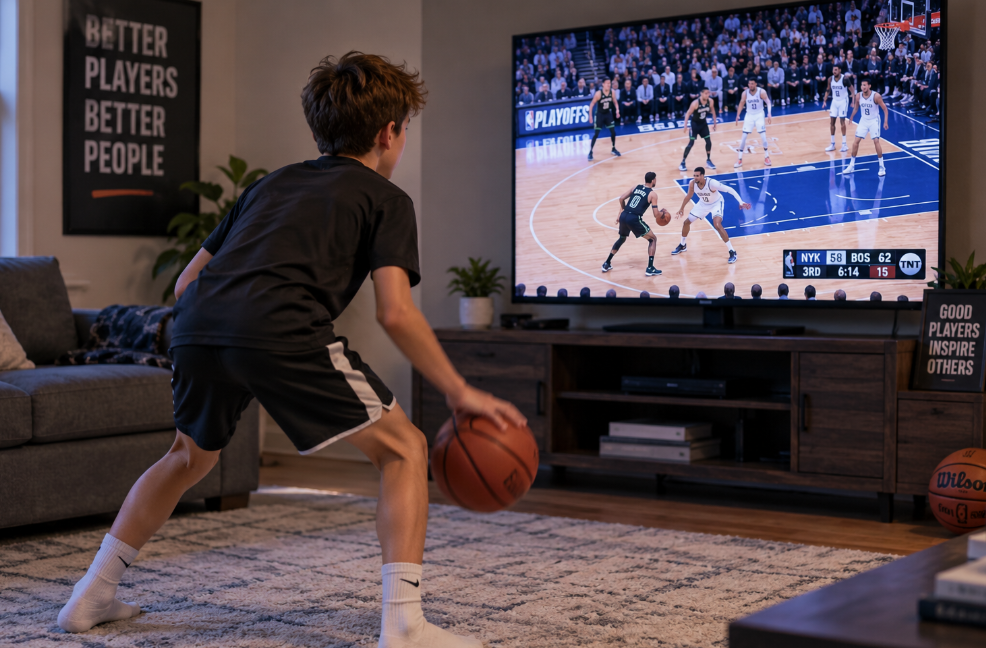
Your child probably watches plenty of basketball. The question is: are they actually seeing the game?
Young players spend hours working on their shot, ball handling and finishing. Those skills matter.
But eventually basketball becomes less about what you can do with the ball and more about knowing what to do next.
Why was that player open?
Why did the defender leave the corner?
Why did the point guard reject the screen?
Why did one player cut while another stayed spaced?
Why was that a good shot with 12 seconds left — but a bad shot with 40 seconds left?
That is basketball IQ.
And one of the best ways to begin developing it happens away from the court: watching basketball with a purpose.
Film study doesn't mean sitting through an entire game
When parents hear "film study," they may picture a high school team sitting in a classroom while a coach rewinds game footage.
It doesn't have to be that complicated.
For a young player, film study can be five or ten focused minutes watching a player who plays their position.
Instead of watching the ball, give your child one assignment:
Watch one player.
Where does that player go when they don't have the ball?
When do they cut?
How do they create space?
Where are they standing when a teammate drives?
How quickly do they make a decision after catching the ball?
What happens immediately after they pass?
Suddenly, they're watching an entirely different game.
When should kids start studying film?
There's no magic birthday when film study becomes useful. The type of film study should change as a player gets older.
Ages 4–7: Just let them watch basketball
At this age, don't turn Saturday afternoon basketball into homework.
Let kids watch exciting players, celebrate great passes, notice hustle plays and fall in love with the game.
Ask simple questions occasionally:
"Did you see that pass?"
"How did she get open?"
That's enough.
The court remains their best classroom.
Ages 8–10: Start teaching them what to notice
This is a good age to introduce the idea that basketball happens away from the ball, too.
Keep it short — perhaps five minutes.
Watch a few possessions and ask one question.
"Don't watch the ball this possession. Watch that player."
Have them notice cutting, passing, spacing, rebounding or defense.
You're not really conducting "film study" yet.
You're teaching them how to watch basketball.
Ages 10–13: Film starts becoming a real development tool
This is where the payoff can become much bigger.
Players are encountering more help defense, screens, ball movement, transition decisions and increasingly organized offensive and defensive concepts.
They can begin asking:
What were my options?
Drive?
Pass?
Shoot?
Cut?
Relocate?
Help defensively?
Stay home on the shooter?
The important part isn't simply watching video.
Players should begin understanding why a decision worked or didn't work.
That's the habit we're trying to build.
Ages 13+: Film can become part of training
By middle school and especially high school, serious players should consider film another form of basketball training.
Not hours of it.
Ten purposeful minutes can be extremely valuable.
This is also when studying players with similar roles becomes particularly useful.
A smaller guard doesn't need to spend every film session studying how an NBA superstar creates isolation dunks.
Study players who solve the same problems you face.
If you're a point guard, watch how guards handle ball pressure and operate pick-and-rolls.
If you're a wing, watch how good players relocate, cut and attack closeouts.
If you're a forward, watch screening angles, short rolls, rebounding position and how players defend multiple positions.
The goal isn't to copy someone's highlights.
It's to steal their decisions.
Don't just watch film. Dribble while you watch.
Here's another way to turn screen time into basketball development:
Put a basketball in their hands.
Find a safe space with enough room to dribble and put on a condensed game, a basketball breakdown or film of a player they want to study.
Then start dribbling.
Nothing complicated is required.
Pound dribbles. Crossovers. Between the legs. Behind the back. In-and-outs. Weak-hand dribbling. Alternating combinations.
The challenge is this:
Keep your eyes on the game — not the basketball.
That's a skill in itself.
Young players often look terrific handling the ball during a drill because their eyes are locked onto it. In a game, those eyes need to be somewhere else.
They need to see defenders.
Teammates.
Cutters.
Help defense.
Open space.
The clock.
The rim.
So instead of doing another 10 minutes of stationary dribbling while staring at the floor, combine two skills.
Train your hands while training your eyes.
Start slowly. The goal isn't to see how fast a player can execute a complicated dribbling combination.
Can they maintain a controlled dribble while actually following what's happening on the screen?
Can they use their weak hand without looking down?
Can they change hands while watching a possession develop?
Can they tell you what happened after the possession ends?
Now film study becomes active training.
Start with your own film
If games are being recorded, this may be the most valuable film your child can watch.
But there's an important rule:
Don't make film night a list of everything they did wrong.
Pick one theme.
For example:
Spacing.
Watch five possessions.
Pause the video just before your child receives the ball.
Ask:
"What do you see?"
Then:
"What are your options?"
Let them answer before playing the clip.
Now you're training recognition and decision-making instead of simply criticizing the result.
A missed shot may have been a great decision.
A made shot may have been a terrible one.
That's an important distinction.
A simple 10-minute film workout
You don't need software, telestrators or a coaching background.
Try this once or twice a week:
Minutes 1–3: Dribble with your weak hand while watching several possessions without stopping.
Minutes 4–6: Switch hands and follow only one player — preferably someone who plays your position.
Minutes 7–8: Put the ball down. Rewatch a few possessions and pause before an important decision. Ask: "What would I do here?"
Minutes 9–10: Pick up the basketball again. Dribble with your eyes up and choose one thing from the film to look for in your next practice or game.
Ten minutes.
You're working on your handle.
You're practicing keeping your eyes off the basketball.
And you're learning the game.
YouTube can actually be useful here
There is a huge difference between watching highlight reels and watching basketball breakdowns.
Highlights show what happened.
Good film study explains why it happened.
A few channels worth exploring:
Thinking Basketball — Excellent for older or more advanced players. The breakdowns explain spacing, decision-making, offensive concepts, defense and what makes elite players effective. Best suited for roughly ages 12–13+.
By Any Means Basketball — Particularly useful for players because the content connects skill development with how those skills actually appear in games. Players can find breakdowns involving footwork, finishing, movement, reads and decision-making. Ages 10+ is a reasonable starting point.
Half Court Hoops — Useful as players become interested in actual basketball actions and X's and O's — screening, offensive sets, spacing and how teams create advantages. Better suited to middle-school and high-school players.
Coach Daniel / Daniel Li — Detailed basketball film breakdowns for players who want to go deeper into the decisions and tactics happening within possessions.
And don't overlook full games and condensed games.
Sometimes the best film study isn't an instructional video at all.
Choose a college or NBA player who plays your child's position.
Watch five minutes.
Ignore the basketball.
Just follow that player.
The "watch the player, not the ball" challenge
Here's an easy experiment for your young hooper.
The next time you're watching basketball together, choose one player.
For five straight possessions, your child cannot watch the ball.
Watch the player instead.
Where are their eyes?
When do they move?
When do they stand still?
When do they cut?
When do they screen?
When do they sprint back?
Where do they position themselves defensively?
Most kids discover something pretty quickly:
The best basketball players are doing something almost all the time — even when they aren't touching the basketball.
That's one of the first big steps toward understanding the game.
Basketball IQ isn't something you're born with
Some players certainly seem to "see the game" earlier than others.
But recognition and decision-making can be developed.
Think about how many situations happen repeatedly in basketball.
A defender helps.
A teammate cuts.
A screen arrives.
A closeout comes too fast.
A big steps up.
The corner opens.
The more of those situations a player learns to recognize, the less unfamiliar they become when encountered at full speed.
Eventually the player doesn't have to think:
"The defender helped from the corner, so somebody must be open."
They see the help.
They make the pass.
That's basketball IQ showing up on the court.
The Shore Hoops Roadmap takeaway
Ages 4–7: Watch basketball for fun.
Ages 8–10: Start teaching kids where to look. Introduce simple eyes-up dribbling while watching.
Ages 10–13: Introduce short, purposeful film study and make Dribble & Watch part of occasional at-home practice.
Ages 13+: Make film part of player development — particularly a player's own games and players who perform similar roles.
You don't need an hour.
You don't need to understand every offense.
And parents don't need to become basketball coaches.
Grab a ball.
Put on a game.
Keep your eyes up.
And start seeing basketball differently.